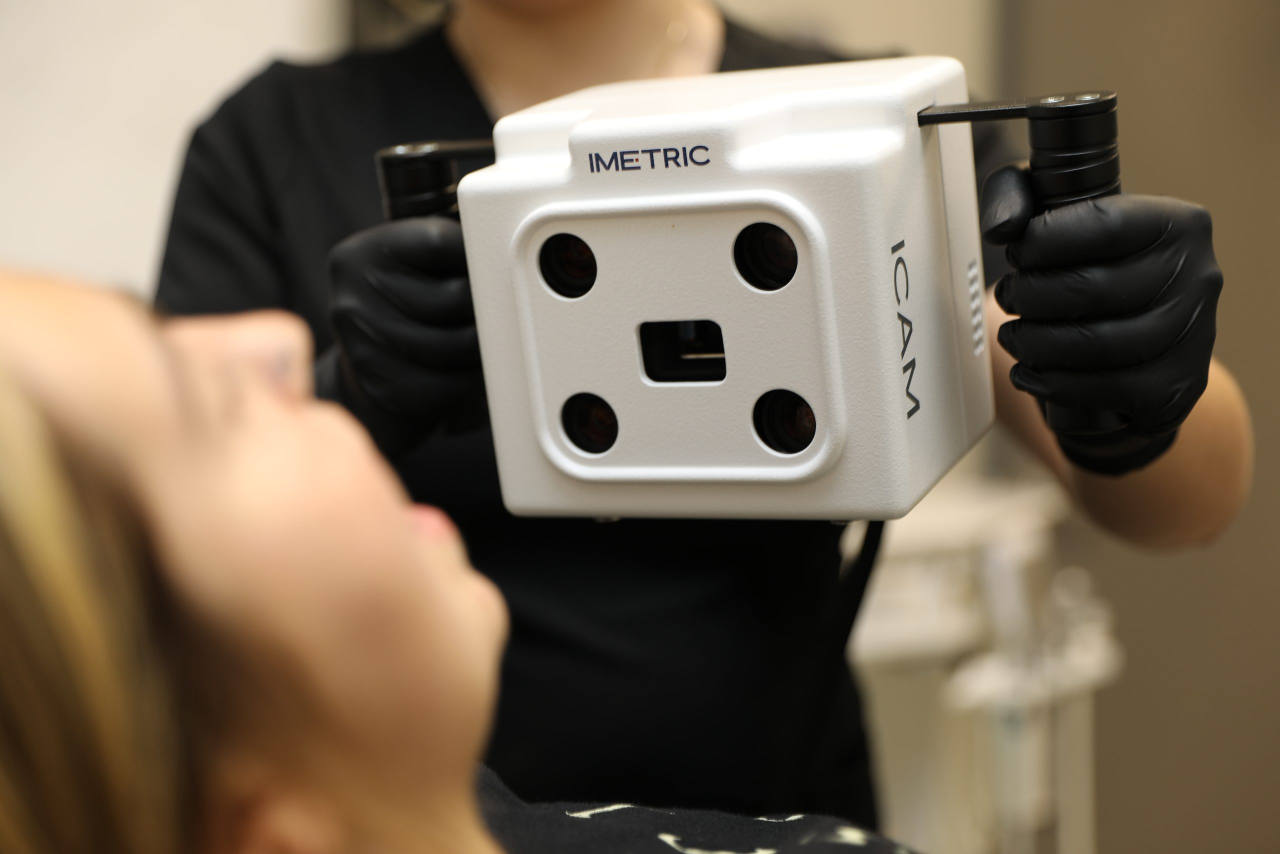
Photogrammetry is the step from analogue impressions to digital precision. We use it in full-arch reconstructions, including Straumann® Pro Arch, where a precise passive fit of the restoration is crucial.
Why traditional methods are not enough
The limits of analogue impressions
Impression trays and materials were the gold standard for a long time. However, the method is time-consuming, technique-sensitive and often unpleasant for the patient — especially for anyone with a gag reflex.
The main risk is distortion of the material. Even the slightest movement while the material sets leads to an inaccuracy that jeopardises the passive fit of the final prosthesis. If the restoration does not fit perfectly passively, unwanted stress builds up in the bone.
The problem with standard intraoral scanners
Scanners are excellent for individual teeth, but with an edentulous jaw they reach their limit. When scanning a whole arch, the software has to stitch thousands of small images together.
Cumulative errors arise at these seams, which can lead to deviations of more than 50–100 microns. For implant work, such a deviation is too large.
What photogrammetry is
Photogrammetry is a digital technique that calculates the absolute 3D position of the implants from multiple images taken from different angles. Unlike a scanner, it does not join images one after another — it sees the whole arch at once.
Accuracy of 4–10 microns
While conventional methods can have a deviation of more than 50 microns, photogrammetry stays within a few microns. This is crucial for the long-term survival of implants.
Vector measurement
We use coded markers that the camera detects with mathematical precision. This rules out image distortion.
Facial integration
We combine the photogrammetry data with a scan of the soft tissues and a face scan. This lets us design your new teeth directly to fit your facial features.
What this means for you
- Precise implant positioning. It allows a passively fitting restoration to be made: zero stress on the implants and bone, which is critical for the success of the treatment.
- Faster completion of treatment. Precision saves try-ins, adjustments and remakes — you get your final teeth sooner.
- A more comfortable process. Fewer visits, less time in the chair and no gagging on impression material.
The digital workflow step by step
- Photogrammetry — implant positions.
- Intraoral scan — gums and soft tissues.
- Face scan — aesthetics in harmony with your facial features.
- Design and manufacture of the restoration in the dental laboratory.
The integration of photogrammetry is one of the most important advances in modern implantology. It allows us to achieve predictable, long-term results in full-mouth reconstructions. We eliminate the errors of manual work and provide patients with restorations that are not only functional and aesthetic but also biologically precise.
MUDr. et MUDr. Filip Donev, gMCP — chief dentist at MALO CLINIC Prague