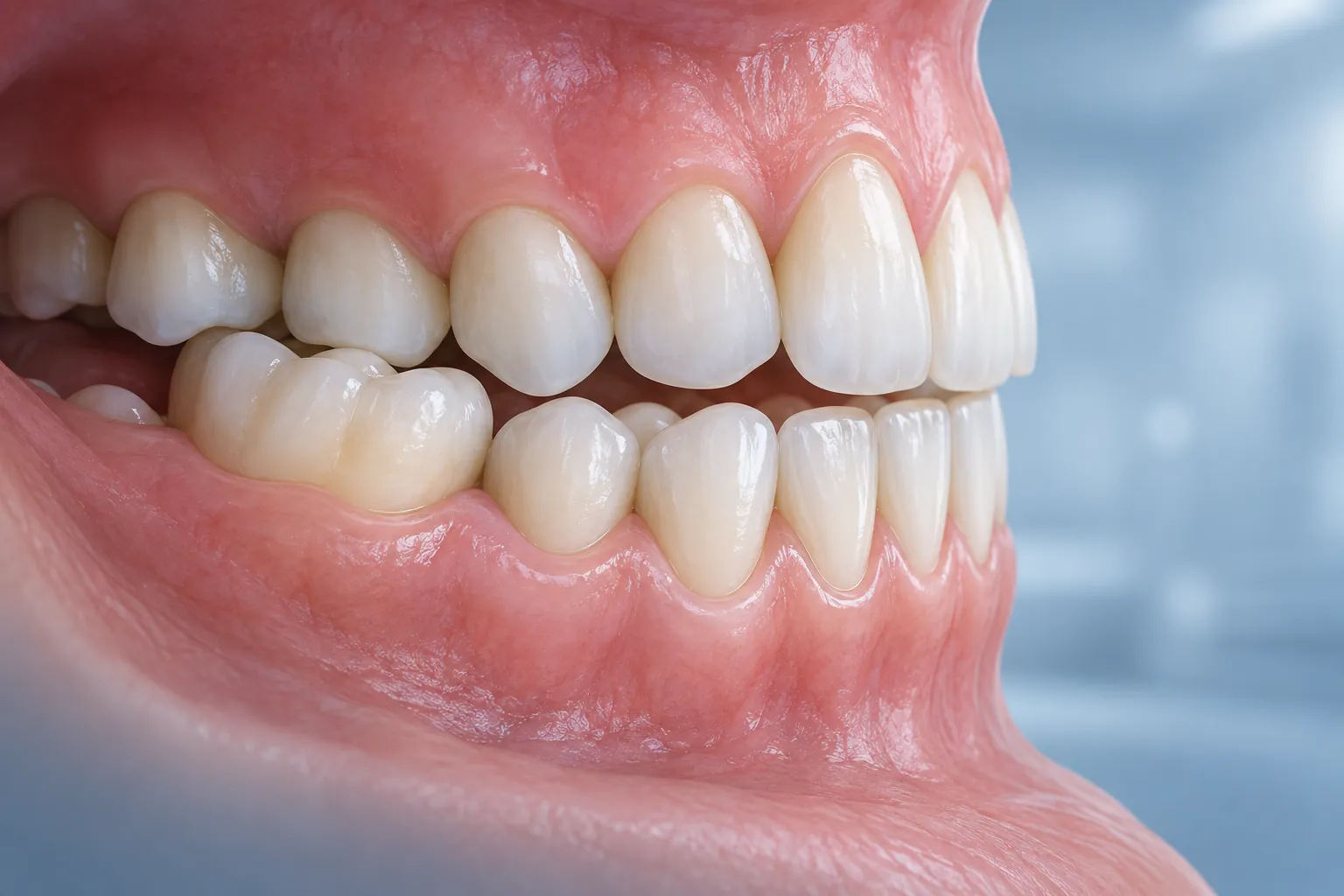
Crossbite
In a crossbite, the upper teeth bite inside the lower teeth. This leads to tooth wear, facial asymmetry and difficulty chewing.
Some of the visualisations on this page were created with AI.
What is a crossbite?
A crossbite occurs when the upper teeth bite inside the lower teeth. It can affect one side or both sides.
The causes may be genetic, functional or developmental: irregular development of the jaws, mouth breathing, uneven chewing or early loss of baby teeth. Habits such as thumb sucking or prolonged dummy use also play a role. Early diagnosis is essential — the problem will not correct itself.
Main causes
A crossbite usually develops due to a combination of factors:
- genetic predisposition
- irregular development of the jaws
- mouth breathing
- uneven chewing
- long-term oral habits — thumb sucking, dummy use
Possible symptoms
Signs vary with the extent and type of the problem. They include tooth wear, difficulty chewing, facial asymmetry, jaw pain and jaw joint disorders.
In children
In children and adolescents, a crossbite can disrupt the normal development of the facial bones; when it affects one side, facial asymmetry is often visible. It can also affect speech, chewing and breathing.
In adults
Besides its effect on appearance, which can affect self-confidence, a crossbite is often associated with jaw joint disorders. Common signs include headaches and jaw pain, clicking, limited opening and closing of the mouth, and ringing in the ears. Incorrect contact between the teeth leads to wear, fractures and gum recession.
If your symptoms persist or get worse, or you notice visible changes to your teeth, have your dentist assess them.
Available treatment
The approach differs fundamentally depending on the age at which the problem is detected:
Treatment in children
A crossbite will not correct itself without treatment, so it is best to start monitoring early. Ideally, the problem is picked up at a preventive check-up. The aim is to widen the jaw, correct the bite and retrain the muscles to work properly — restoring both chewing and speech.
Treatment in adults
In adults, treatment takes longer because the bone is firmer. With the right guidance and the patient’s cooperation, however, a functional and healthy bite can be achieved. Exceptional and complex cases require orthognathic surgery to correct the position of the jaws.
Where we can help
We provide examination and treatment in these areas of care: